
Startseite » Material selection for special screws: A2, A4, steel or special alloy?
A foundational article for design engineering and technical procurement:
capturing requirements, classifying material groups and avoiding
typical misconceptions when specifying custom components.
Materials Knowledge Area & Surfaces
Reading time: 8 minutes
Material, strength, surface finish
A2, A4, steel, special alloy
Environment, load, assembly, verification
Information for Drawings and Inquiries
The right material for custom bolts cannot be determined from a single parameter. What matters is the interplay of operating environment, mechanical load, temperature, surface finish, assembly conditions and required documentation.
This article outlines a practical decision-making logic. It does not replace standards interpretation, but it helps structure technical requirements so that design, procurement and production are working from the same specification.
Definition
For a custom bolt, the material is part of the function. It determines not only corrosion behavior and strength, but also machinability, heat treatment, coatability, coefficient of friction, inspection effort and availability.
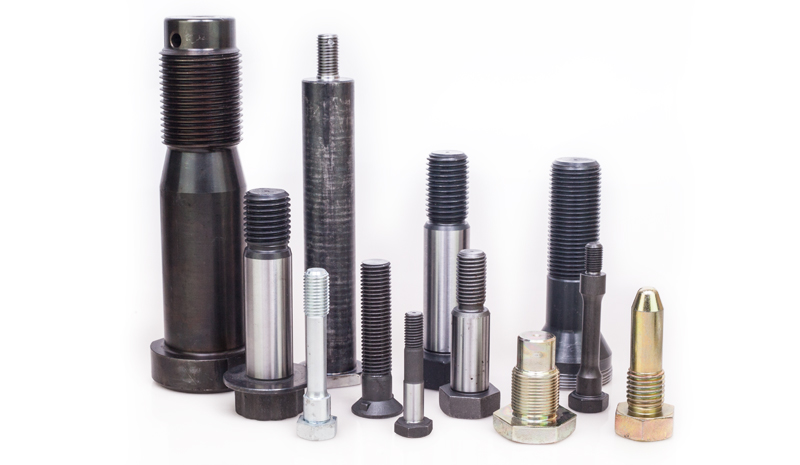
Selection criteria for the material used in custom fasteners
A robust choice of material starts with the application. Key factors include moisture, chemicals, salt, temperature, dynamic loads, required preload forces and whether the connection is to be loosened on a regular basis.
A2 and A4 describe stainless steel groups, but they do not constitute a complete technical specification. For a drawing or an inquiry, further details must be added: dimensions, thread, strength, surface finish, tolerances and certifications.
Verification logic: first define the operating environment and load case, then narrow down the possible material groups. Surface finish, coefficient of friction, certifications and supply capability are then reviewed.
| Material Group | Typical Application | What to Consider |
|---|---|---|
| Stainless Steel A2 | General applications with moderate corrosion exposure, commonly indoors or under normal ambient conditions. | Not automatically suitable for saline, chloride-containing or chemically aggressive environments. |
| Stainless Steel A4 | Outdoor use, moisture exposure, elevated corrosion requirements and certain media contact. | Mechanical requirements, temperature and media resistance still need to be checked separately. |
| Quenched and Tempered Steel | High strength, load-bearing connections, mechanical engineering, defined strength classes. | Corrosion protection must be defined via surface finish or coating; hydrogen embrittlement must be considered for high-strength parts. |
| Special Alloy | Temperature, chemical exposure, special media, long service life or customer-specific material specifications. | Availability, machinability, minimum order quantities and certifications should be clarified early. |
Material grade and strength level are often conflated. A stainless steel designation does not automatically indicate what preload can be achieved. Conversely, a high strength class without suitable corrosion protection can be the wrong choice for a given application.
The surface finish affects not only corrosion protection but also assembly and the coefficient of friction. On high-strength screws, the wrong coating can cause problems; on stainless steel, passivation, media contact and the risk of galling all come into play.
Typical requirements include zinc-nickel, zinc flake, black oxide finishing, passivation or customer-specific surface finishes. Which solution is suitable depends on the application and on the required standards or plant specifications.
To ensure a technical clarification can begin quickly and produce reliable results, the following information should be provided as completely as possible:
Specification in brief: Function, environment, load, surface and verification requirements should be defined together. Individual specifications such as “A4” or “high-strength” are usually only the starting point.
A2 is suitable for many standard applications with moderate corrosion exposure. In the presence of salt, aggressive media or persistent moisture, the environment should be assessed more closely.
A4 is often selected when higher corrosion resistance is required, for example outdoors or in damp environments. Mechanical suitability must still be verified separately.
Not entirely. Coatings can influence corrosion resistance and friction values, but they do not change the base material’s fundamental characteristics.
It describes mechanical requirements and should be considered separately from the material group. A robust specification only results when this is combined with environment, surface and assembly conditions.
It is helpful to provide a drawing or sample, operating environment, load, quantity, surface finish, strength requirements and desired certifications.

Certified quality: PATTBERG MBT has been certified to DIN EN ISO 9001 since 2008 and, since 2024, additionally to DIN EN ISO 14001.
A few key facts are often enough for an initial assessment: operating environment, load, desired surface finish, quantity, and any existing drawing or sample. From this, it can be determined which material groups should reasonably be evaluated.
Quick technical query to PATTBERG MBT